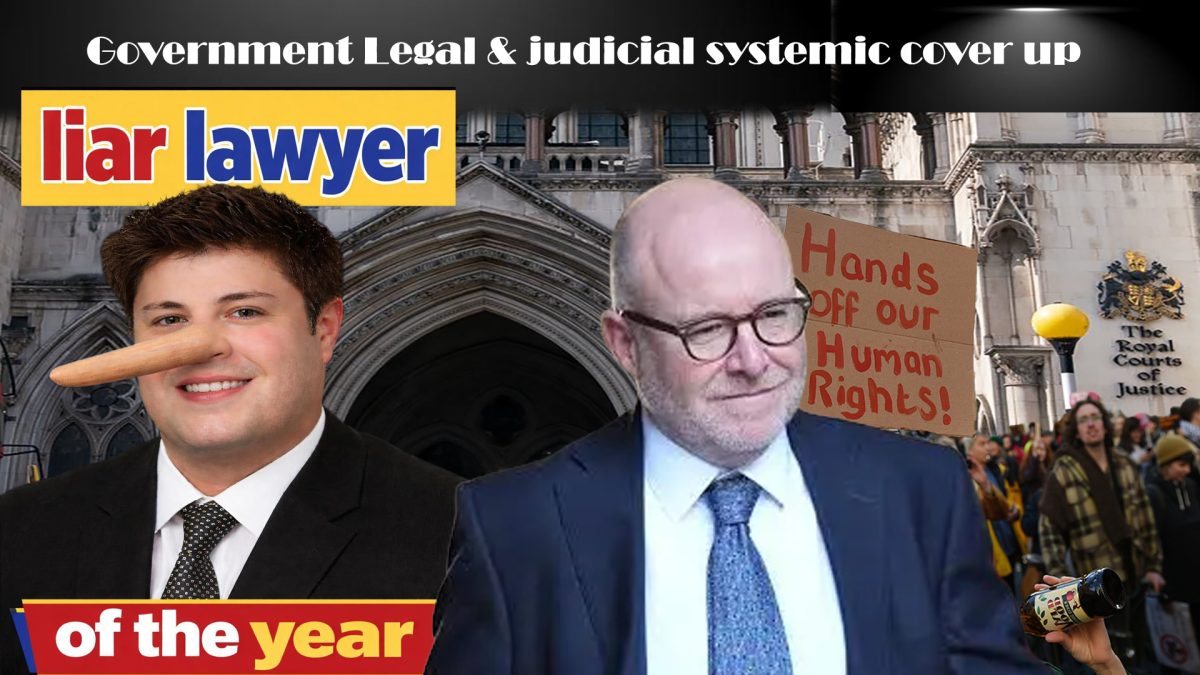

Pictured left: Tom Shepherd – 4 New Square Chambers. Jemima Stephenson – New Park Court Chambers. Right: Nick Cartmell – New Park Court Chambers. Far right: HHJ Prince of Newcastle Crown Court
UK Courts in crisis: Justice for Sale as Constitutional Safeguards Collapse and Courts Become “Judge, Jury and Protector”
The foundational pillars of English constitutional law—judicial independence, the right to a fair trial, and equality before the law—are facing an existential crisis, legal observers warn, as a pattern of procedural manipulation and institutional protection emerges across multiple cases in the UK court system.
At the heart of the controversy lies the case of R v Paul Millinder (A-2021-0089), where official court transcripts allegedly document a systematic suppression of a defendant’s statutory defence.
His Honour Judge Prince is recorded acknowledging that “anybody who’s been defrauded… is going to be cross about it,” yet refused to examine evidence of the underlying fraud, insisting he was “here to deal with the emails.”
Court-appointed counsel purportedly abandoned 116 prepared questions designed to expose a £4.1 million fraudulent proof of debt, instead conducting superficial cross-examinations that validated the prosecution narrative—despite eliciting admissions that would ordinarily compel acquittal.
The Millinder case is not isolated. Across England’s courts, litigants in person report being denied access to evidence, facing judges with undisclosed conflicts of interest, and watching as procedurally defective proceedings proceed unchallenged when the accused threatens powerful institutions or well-connected professionals.
UK courts: Justice for sale and inversion of the English rule of law
“What we are witnessing is the inversion of the rule of law,” said one constitutional law academic who requested anonymity. “The principle that no one is above the law has been replaced by a two-tier system: one set of rules for ordinary citizens, another for the judiciary, major law firms, and politically connected defendants.“

The constitutional damage extends beyond individual miscarriages of justice. When District Judge Currer allegedly presided over committal proceedings despite having previously represented the complainant—Middlesbrough FC—without disclosure or recusal, the principle of judicial impartiality was not merely bent but shattered.
When the Master of the Rolls and multiple Court of Appeal judges allegedly refused to examine evidence of fraud presented in appeals, the constitutional safety valve designed to correct lower court errors became an instrument of its concealment.
Legal historians point to the Magna Carta’s promise that justice will not be denied or delayed, and to the Bill of Rights 1689’s protection against partial juries and corrupt officials. “These are not archaic parchments,” noted a retired High Court judge. “They are living constitutional guarantees. When courts protect alleged fraudsters because they are solicitors, when judges refuse to recuse despite conflicts, when appeal courts uphold convictions obtained through suppressed defences—the entire system loses legitimacy.”

If it means getting them removed in handcuffs – then that’s what we will do.
Judicial corruption: The implications are profound
The implications are profound. If the judiciary can conspire to exclude exculpatory evidence, if law firms can commit alleged multi-million-pound frauds with impunity because their victims’ complaints are recharacterised as harassment, and if ministers responsible for justice decline to investigate judicial misconduct, then England no longer operates under the rule of law but under the rule of men—precisely what the constitutional settlement of 1688 was designed to prevent.
Calls are mounting for a royal commission into systemic corruption within the justice system, independent prosecution of judges and lawyers accused of conspiracy to pervert the course of justice, and restoration of meaningful parliamentary oversight of the judiciary.
The English Constitution – once the envy of the world – risks becoming a hollow facade
Without urgent reform, critics warn, the English constitution—once the envy of the world—risks becoming a hollow facade concealing a system where power, not principle, determines outcomes.
The Lord Chancellor’s office declined to comment. The Judicial Conduct Investigations Office has not responded to requests for information on complaints filed against the judges named in the Millinder case. Womble Bond Dickinson solicitors declined to comment.
As one litigant put it: “I came to court seeking justice. I found only a cartel protecting its own.”
Judicial corruption: The English constitutional crisis that strikes at the separation of powers itself
The systematic suppression of statutory defences and exclusion of exculpatory evidence in cases like R v Millinder represents a constitutional crisis that strikes at the separation of powers itself.
When judges refuse to permit examination of underlying fraud because it implicates well-connected solicitors, they transform the judiciary from impartial arbiters into active participants in concealing criminality.
This judicial overreach inverts the constitutional balance: Parliament enacts defences like Section 1(3)(a) of the Protection from Harassment Act 1997 to protect citizens reporting crime, yet judges nullify those statutory protections through procedural manipulation.
The result is an unconstitutional usurpation of legislative authority, where unelected judges effectively repeal Acts of Parliament by rendering them unenforceable when invoked against the legal establishment. This undermines parliamentary sovereignty—the bedrock of the British constitution—and creates a judicial aristocracy accountable to no one.
Without functioning checks on judicial misconduct, England regresses to a two-tier justice system where rights exist only on paper, justice is distributed according to social status, and the constitution itself becomes a dead letter—precisely the tyranny that centuries of constitutional development were designed to prevent.