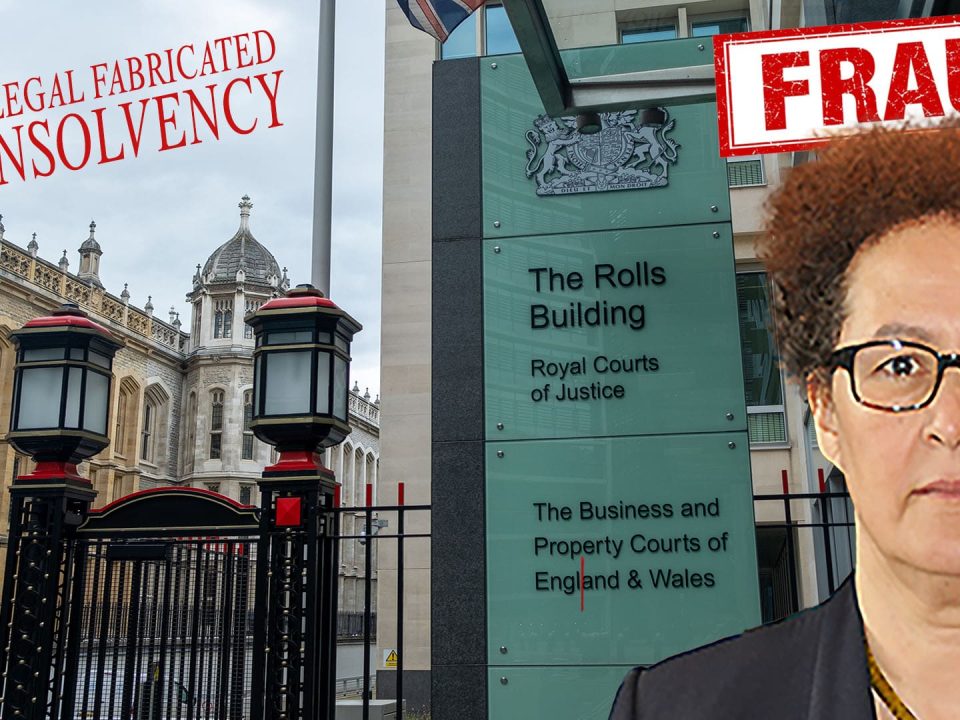

WIDESPREAD ABUSE OF CIVILIAN RIGHTS: Law on ‘Totally Without Merit” and civil restraint orders is being abused to stymie good claims and to defeat the ends of justice. Bottom right: Former Judge HHJ Pelling – a prolific perpetrator of unlawful ‘TWM’ certification
1. What’s the motive for misuse of the law on civil restraint orders and ‘TWM’?
1.1. Suppression of Legitimate Claims
Powerful entities or individuals may attempt to prematurely brand a valid lawsuit as “vexatious” to obtain a CRO, effectively freezing a claimant’s ability to seek redress.
1.2. Procedural Bypass
In jurisdictions like Hong Kong and the UK, CROs (such as Extended or General Civil Restraint Orders) require a judge’s permission before further applications can be filed. Misuse occurs when courts are pressured, or judges are coerced into imposing these orders without the rigorous public policy and evidentiary standards of ‘Totally Without Merit’ being met.
1.3. Asymmetric Power Imbalances
There’s wholesale abuse inflicted on civilians with corrupt corporations and their representatives misapplying the law on ‘TWM”, pursuing CROs against under-resourced or unrepresented individuals (Litigants in Person) to intimidate them into dropping valid claims.
1.4. Strategic Stalling
Filing unwarranted applications for CROs can be used as a stalling tactic to drain an opponent’s time and financial resources, even if the CRO itself is ultimately denied.
2. It takes two to tango: In absence of the judge misapplying or misusing the law – there is no abuse
The finger of blame for such prolific abuse of one’s right to a fair trial and access to justice in cases where CROs, ECROs (Extended Civil Restraint Orders), GCROs (General Civil Restraint Orders) and even Section 42 Senior Courts Act 1981 permanent orders are wrongfully made, always points at the judge.
The unscrupulous lawyer may make the application to restrain, or to certify as ‘TWM’, but actually getting there, requires the judge to play along.

3. What are the Court of Appeal’s established curbs to abuse of the law on civil restraint orders and ‘Totally Without Merit’?
3.1. Public Policy Determinations: The Balancing of Competing Interests
Both Court of Appeal judgments on the issue of ‘TWM’ (Grace & Wasif) explicitly identify the competing public policy interests that the court must balance when applying the TWM filter.
3.1.a. The Policy of Court Efficiency and Resource Protection
- The Problem of “Hopeless” Case Growth: In Grace (at paragraph 13), the Court of Appeal explicitly identified the public policy driver behind the TWM rules: to address the “exponential growth in judicial review applications” which had resulted in “a significant number of hopeless applications.”
- Proportionality: These hopeless cases place an “unjustified burden on the resources of the Administrative Court and the Upper Tribunal” and cause unnecessary trouble and expense to public authorities.
- The True Purpose of TWM: The Court of Appeal in Grace rejected the argument that TWM should only apply to “vexatious” or “abusive” litigants (the historic Civil Restraint Order context). Instead, the court determined that as a matter of public policy, any case that is “bound to fail” must be weeded out early to protect the justice system’s integrity and resources, regardless of whether the claimant is acting in bad faith.
3.1.b. The Constitutional Importance of Judicial Review and Article 6 ECHR
- Access to Justice: In both Grace (paragraph 15) and Wasif (paragraph 16), the court recognized that depriving a claimant of an oral renewal hearing is a severe curtailment of their access to the court.
- Maintaining Constitutional Safeguards: The court determined that the TWM process is only constitutionally permissible and compliant with Article 6 of the European Convention on Human Rights (ECHR) if it is accompanied by rigorous, high-level judicial safeguards.
3.2 Judicial curbs to prevent the misuse of “TWM”
To ensure that the public policy goal of efficiency does not override the constitutional right to access a court, the Court of Appeal established strict and absolute judicial curbs, curbs we find are being affronted and violated by the judiciary of England and Wales, wholesale.
3.2.1. Curb 1: Defining TWM as a High and Distinct Threshold (“Bound to Fail”)
- Distinct from “No Realistic Prospect of Success”: In Wasif (paragraphs 13 and 15), the court established a vital curb: refusing permission and certifying a case as TWM are two distinct exercises with different thresholds.
- The “Bound to Fail” Standard: A judge must not certify a case as TWM simply because they are confident the claim is wrong and must be refused permission. A case is only TWM if it is “bound to fail”—meaning that, taking the claimant’s case at its highest, there is “no rational or realistic route by which the claim could succeed in law or on the facts” (Wasif, para 20).
- Preserving the Right to Oral Advocacy: If a claimant has a rational, coherent argument that the judge ultimately rejects on the papers, permission should be refused, but it must not be certified as TWM. This preserves the claimant’s right to try and persuade a judge via oral advocacy.
3.2.2. Curb 2: The requirement of “peculiar care” and rigorous judicial reasoning
- No Automatic Certification: Judges are explicitly curbed from treating TWM as an automatic consequence of refusing permission (Wasif, para 17(1)).
- The “Peculiar Care” Safeguard: In Grace (para 15) and Wasif (para 17(2)), the court ruled that a judge must only certify a case as TWM if they are “confident after careful consideration” that the case is truly hopeless, keeping in mind the gravity of the issue and the consequences to the individual.
- Heightened Standard of Written Reasons: In Wasif (paragraphs 19 and 20), the court established that because a TWM certificate ends the road for a claimant (subject to a paper-only appeal), the judge must take “peculiar care” to write adequate, individualized reasons.
-
- The judge must identify and address all of the claimant’s substantive arguments individually.
- If the grounds are discursive or confused, the judge must actively analyze them into their component parts and explain why each fails.
- Separate Reasons for TWM: Wasif (paragraph 21) introduced the judicial curb that judges must give reasons for the TWM certification separately from the reasons for refusing permission. This forces the judge to consciously justify why the case crosses that higher, more stringent threshold.

COURT OF APPEAL BINDING AUTHORITY: When considering a Totally Without Merit certification judges first first take ‘peculiar care’ to ensure all the argument in the grounds is properly addressed.
3.2.3. Curb 3: Giving the Claimant the “Benefit of Any Real Doubt”
- Addressing Weaknesses: In Wasif (para 17(3)), the court noted that oral renewal hearings allow claimants to address weaknesses they might not have anticipated. A judge must only certify a case as TWM if they are satisfied that an oral hearing could serve no such purpose. If there is any real doubt, the claimant must get the benefit of that doubt and not be certified TWM.
- Unrepresented Litigants with Poorly Presented Claims: In Wasif (para 17(5)), the court curbed the practice of certifying poorly drafted claims as TWM. If a claim is too confused to grant permission, but the judge suspects that “proper presentation might disclose an arguable basis of claim,” they must not certify it as TWM. They should refuse permission normally, allowing the claimant the chance to clarify their case at an oral hearing.
- No TWM on Unanswered Summary Grounds: In Wasif (para 17(6)), the court ruled that a judge should not certify a claim as TWM based on points raised in the defendant’s Summary Grounds of Defence (Acknowledgment of Service) to which the claimant has not had a fair opportunity to reply.
3.3. Summary of the Curbs
|
Aspect |
The Risk of Misuse |
The Judicial Curb (from Grace & Wasif) |
|
The Threshold |
Treating TWM as a default stamp for any refused permission application. |
TWM is a distinct, higher threshold. The case must be “bound to fail” with no rational route to success. |
|
Judicial Discipline |
Conflating the refusal of permission with the TWM certification. |
Judges must provide separate, distinct reasons justifying why the case is certified TWM. |
|
Poor Presentation |
Penalizing unrepresented litigants who cannot draft professional pleadings. |
Do not certify TWM if proper presentation or oral clarification might reveal an arguable point. |
|
Unilateral Arguments |
Relying solely on the Defendant’s written submissions to certify TWM. |
4. ROBUST PRIVATE ENFORCEMENT ACTION in the public interest: The Judicial Conduct Investigations Office is unfit for purpose
The purported judicial regulator, the Judicial Conduct Investigations Office is, in our wide experience, ignorant and absolutely detached from the widespread abuse suffered by civilians due to judges deciding on the day that judging in a given case, is not for them.
Misuse of the law on ‘Totally Without Merit’ and civil restraint orders nearly always comes into that mix.

If it means getting them removed in handcuffs – then that’s what we will do.
4.1. What we are doing to curb the abuse
IUK will investigate and in many cases assist in the civil and potential criminal prosecution of any judicial officer in the UK who is established to have misused the law on ‘TWM’ or civil restraint orders.
IUK will publish reports on their conduct, and we shall expose them via our leading niche portal. There’s a cure for corruption, and that is transparency.
4.2. The cases we are currently taking forward in the public interest that confront this abuse
IUK is currently involved in two high profile cases involving prolific and blatant affronts to the law on ‘TWM’ and civil restraint orders. You can read more about those in the our cases section of our website.
4.2.1. Perseus Ventures Limited v LPA Receivers, Barclays Bank PLC & Addleshaw Goddard LLP
In summary, PERSEUS VENTURES LIMITED, (“PVL”) is a B.V.I property company.
Suzan Caryl Cohen, real name, Susan Carol Veale was a Conservative Party “Information Officer” who handled correspondence to then Prime Minister, David Cameron MP and Cabinet ministers (2015-2017). Veale orchestrated a £700,000 fraud whilst an undischarged bankrupt.
IUK proved that Veale had committed the indictable offence of Section 11(1) Company Directors Disqualification Act 1986.
Operating under six aliases and ten different birthdays, Cohen, AKA Veale, was declared bankrupt in August 2009. Just 16 days after swearing she had “no connection” to 94 Rope Street London in bankruptcy proceedings, Veale forged a 10-year lease on the riverside property, collecting approximately £675,000 in income, illegally derived from PVL’s property.
While bankrupt and illegally acting as company director — Veale, then branding herself as Mrs Walsh, although never marring a Walsh, Ms Bleach, Ms Downing and Ms Grant (amongst other aliases) – donated £9,000 to the Conservative Party in 2015. Proceeds of crime – according to Section 340 Proceeds of Crime Act 2002.
PVL, Veale’s solicitor who allegedly witnessed the lease, and court documents, all confirm the lease is forged. Under Veale’s instruction, unknown individuals broke into the property in 2019, converting it to studio apartments.
Despite PLV obtaining a possession order on 26 July 2023, police refused to act, calling it a “civil matter.”
Cohen, AKA Veale, was previously exposed for circulating fake anti-Corbyn propaganda, is now believed to have fled to Canada. The case raises serious questions about government vetting and political accountability.
4.2.1.a. Barclays Bank PLC alleged false accounting, embezzlement and the LPA Receivers who deliberately did not receive
On 17 JUNE 2026 – PVL was in Court before Mr Justice Dexter Dias arguing that that ECRO made against it by Mr Justice Soole on 17 December 2025 is void through want of jurisdiction.
Outstanding barrister and leader of Ruper Lowe MP’s Rape Gang Inquiry, Graham Smith, represented PVL following IUK’s forensic investigation into the case where irrefutable fresh evidence of fraud and false accounting was put forward.
The overriding principle and importance of PVL’s case in context with this report, is that successive ‘Judges’ certified as ‘TWM’ but without even touching upon, the crucial deed of appointment binding the contractual and fiduciary duty of the LPA Receivers to have received “rent and all other income derived from such property”.
In PVL’s first draft 17-page skeleton prepared by IUK to assist counsel in getting to the facts, page 10, recited real evidence from a transcript of a call of 18 August 2023 between PVL and David Foskett of Copping Joyce, one of the Joint LPA Receivers for Barclays, where Mr Foskett admitted:
“And at that juncture, all the rent has been going to Suzanne Veale. It’s quite straightforward.”
“So then from that moment onwards, all that’s happened is Suzanne Veale has taken the rent and notwithstanding my lawyers and dealing with her lawyers and this, that and the other, she has kept the rent.“
On the same call, Mr Foskett further admitted:
“And since that period of time, I have, as the receiver, have been trying to get the bank to pursue a possession order for, well, since 2019.“
Similarly, it is common knowledge that LPA Receivers have a duty, acting as fiduciary agent for the borrower (PVL in his case) have a duty to provide ‘effectual receipts’.
Yet in PVL’s case the LPA Receivers and their lawyers refused to provide any completion statement when they sold the Property for 841,000 on 5 September 2024.
Similarly, on 9 May 2018, exactly 8-weeks from signing their deed of appointment binding them to the contractual duty of receiving all income derived from the Property, in a letter from the LPA Receivers to PVL, they confirmed they knew of their obligations:
“We have written to Live Work Study London to inform them that the rent is due to us, and that any rent payable to White Mid Sloan LTD will be lost, as it is still due to us. This is in spite of the co-director of White Mid Sloan LTD, Ms S. Veale assumption that the receivers do not collect the rent.”
Contrary to public policy, successive ‘Judges’ of the High Court King’s Bench Division; (1) Master Brown, (2) Collins-Rice J, (3) Murray J and then (4) Soole J, certified PVL’s case at ‘TWM’ but whilst in our learned view following forensic investigation, taking “peculiar care” to conceal and evade the proven case against the LPA Receivers and Barclays Bank PLC for failing in their fiduciary duty to have received over 675,000 in income derived from the property under receivership that would otherwise have redeemed the loan of 456,547.63.
4.3. The million pound question – Can a Judge conceal wrongdoing to silence the victim?
With allegations and fresh evidence of alleged false accounting and fraud by false representation presented to the Court, the simple question arises:
DO COURTS AND JUDGES HAVE JURISDICTION TO CONCEAL WRONGDOING, INCLUDING FRAUD AND POTENTIAL CRIMINAL OFFENCES WITH A CIVIL RESTRAINT ORDER – BUT WITHOUT FIRST EVEN TOUCHING UPON – LET ALONE DETERMINING THE POINTS AT ISSUE?
That is a question RESERVED TO THE JUDGMENT OF MR JUSTICE DEXTER DIAS following the ‘hearing’ on 17 June 2026. We shall report on the case once judgment is handed down.
4.3.1. The Millinder Case – Judicial fraud and alleged perversion to prevent justice being served on Middlesbrough FC, ‘layers of liar lawyers and judges’ and police who cover up crimes
In what is without question the most serious judicial scandal in English history, IUK’s Operation Blackjack 5-year forensic investigation revealed a pattern of successive ‘Judges’ who decided that judging in Mr Millinder’s case was not for them.
On 25 March 2022 IUK acquired the legal rights to Mr Millinder’s multi-million pound claim against Middlesbrough FC, two senior Official Receivers of the Insolvency Service who acted as liquidators of both Mr Millinder’s companies, the Lord Chancellor, and H.M.C.T.S.
Multiple senior H.M.C.T.S judges are accused of fraudulently failing to administer the mandatory engaged rule of due process, insolvency set off (14.25 Insolvency Rules 2016).
The set off rule was automatically engaged in respect of Empowering Wind MFC Ltd (“EW”), and it’s £9.2 million net quantified damages claim against Middlesbrough FC (“MFC”), when on 15 August 2016, MFC fraudulently claimed to be creditor of EW in the sum of £256,269.89. The mandatory law required that the MFC claim be 100% set off against the 9.2 million net claim vested in EW, prior to contemplating making a winding up order against EW. On 19 September 2016, the former Chief Registrar Baister colluded with MFC’s barrister, acting ‘in fraud upon the bankrupt laws’ winding up EW to defraud it of the claim that was to have been set off. Mr Hannon, the liquidator of EW went on to fail to administer the same mandatory scheme of law, 3 times over, enabling the Club to fraudulently claim to be creditors in the sum of 256,269.89 – 541,308.89 and then 4,111,874.75 all arising from their first unwarranted claim, that law intended be set off entirely.
The same fraud was perpetrated in respect of Mr Millinder’s sole purpose holding company, Earth Energy Investments LLP. On 29 June 2015 EW assigned the investment made by Millinder in EW to EEI, after MFC made an unwarranted demand, threatening to forfeit the lease, unless Millinder / EW paid them 256,269.89 unconditionally, after the Club refused the connection on 30 April 2015, preventing EW from performing on the contractual rights granted.
On 6 January 2017 EEI served the Club a statutory demand for 530,000 of its assigned investment. On 28 March 2018, the ‘danger to the public’ and lawless ‘Insolvency & Companies Court Judge’, ICC Judge Barber, defeated a High Court Judges order of 21 March 2018, and bypassed the mandatory law, enabling MFC to defraud Millinder of his assigned investment using fraudulently manufactured insolvency proceedings to ensure the Club evaded justice.
Successive judges, over 21 involved in the conspiracy, certified as ‘TWM’, deploying a range of civil restraint orders against Millinder personally, whilst dishonestly failing to touch on:
- The completed terms of the contracts affirming that EW owed no money to MFC
- The insolvency court’s ‘duty of inquiry’ and no res judicata where it be shown that there is no debt owed to the creditor in truth and reality
- The mandatory engaged rule of due process; Insolvency set off
- The automatically engaged anti-deprivation principle that was nullified MFC’s 4,111,874.75 proof of debt for defeating the pari passu distribution amongst the body of EW creditors, as much as it did MFC’s 25,000 the mandatory rule intended be set off.
As a matter of principle, judges and courts are not permitted to conceal crucial facts and evidence, or wrongdoing in any form, by deployment of civil restraint orders founded upon fraudulent and purported ‘TWM’ certifications, without first taking “peculiar care” to ensure that the argument / issues are first properly addressed. Doing so is a violiation of the public policy rule, and is ultra vires.
The proof is in the pudding.